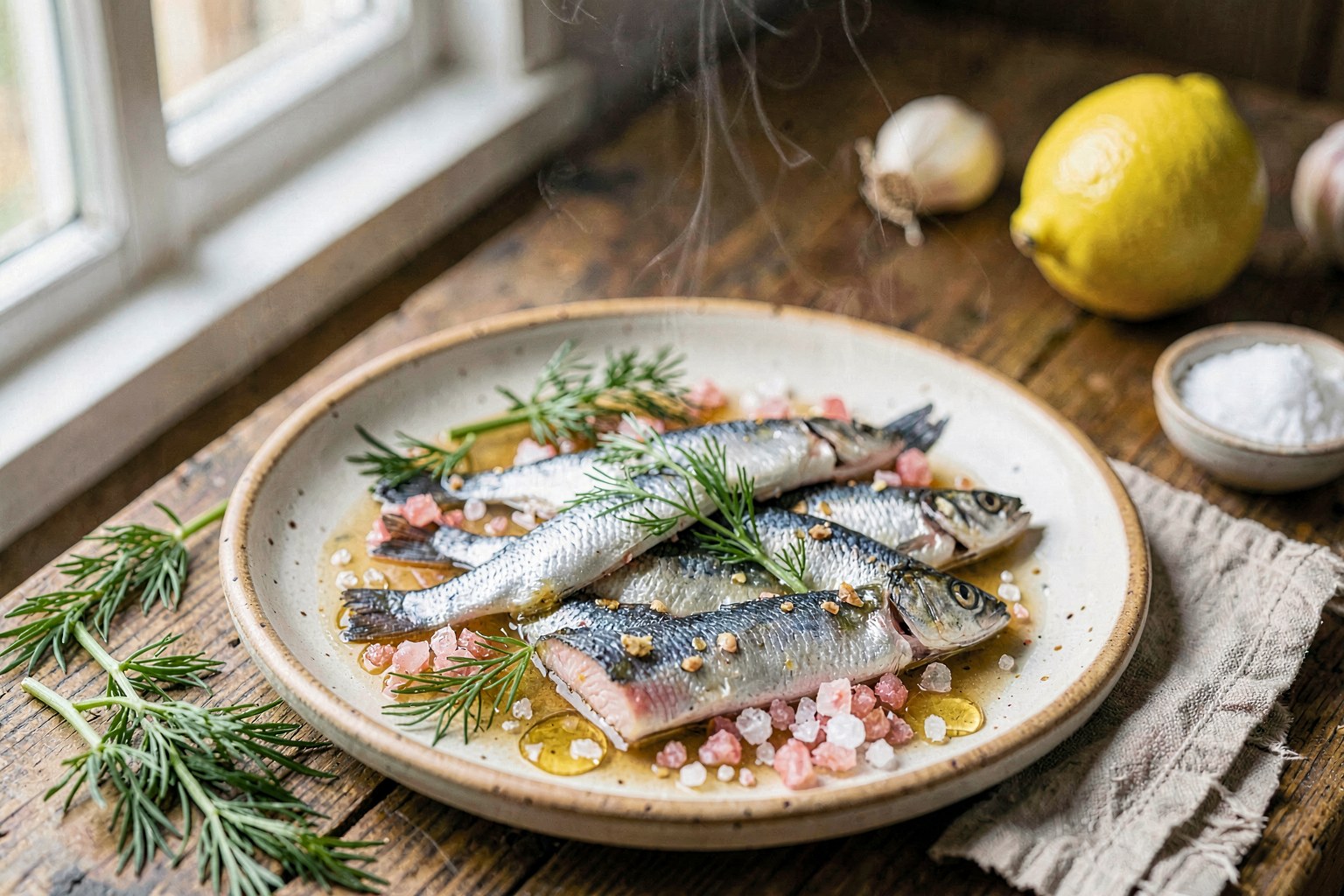
Cold Water Smelt Cured with Dill (Nordic Clean Tradition)
Tiny, silvery smelt are gently cured in a brine of sea salt, fresh dill, and a whisper of raw honey to honor the Nordic tradition of preservation without refined sugar. This dish offers a delicate, briny crunch and a burst of omega-3s, served chilled as a sophisticated, nutrient-dense dinner starter or light main.
A little context
In traditional Scandinavian winters, small fish like smelt or whitefish were cured in salt and dill to survive the cold months, often with a touch of sugar to balance the salt. We honor this preservation method by substituting refined cane sugar with a minimal amount of raw honey or date syrup, maintaining the flavor balance without the inflammatory load. The recipe strictly avoids seed oils and ultra-processed shortcuts, relying instead on the natural fats of the fish and the freshness of farm-grown herbs.
The longevity story
Smelt are small, short-lived fish that accumulate minimal heavy metals while providing a dense profile of EPA and DHA omega-3 fatty acids, essential for cellular membrane integrity and reducing systemic inflammation. The brine relies on fresh dill, rich in apigenin and quercetin, which act as potent antioxidants to support vascular health. Using raw honey sparingly introduces trace enzymes and prebiotic compounds, while the absence of processed sugars prevents the glycemic spikes that drive glycation and aging.
Method
- 01
Prepare the Brine
In a small saucepan, combine the filtered water, sea salt, and raw honey. Warm gently over low heat just until the salt and honey fully dissolve; do not boil. Remove from heat and allow to cool completely to room temperature, then chill in the refrigerator until cold.
- 02
Prep the Smelt
Rinse the wild-caught smelt under cold running water and pat them thoroughly dry with clean kitchen towels. If using whole smelt, butterfly them by slicing down the back and opening them flat, removing the backbone if desired for easier eating, or leave whole for a more rustic presentation.
- 03
Layer the Curing Vessel
In your glass jar or ceramic dish, create a bed of half the chopped fresh dill, half the lemon zest, and half the black pepper. Arrange the smelt in a single layer on top of the herbs, ensuring they do not overlap excessively.
- 04
Add Remaining Aromatics
Sprinkle the remaining dill, lemon zest, and black pepper over the top of the fish. Pour the cold brine over the fish until it is completely submerged. If necessary, place a small clean glass weight or a small plate on top to keep the fish under the brine.
- 05
Cure in the Cold
Cover the vessel tightly and refrigerate. Allow the fish to cure for 45 minutes to 1 hour. Smelt are small and delicate; leaving them longer than 2 hours will result in a texture that is too firm and salty.
- 06
Drain and Dress
Remove the fish from the brine and gently pat dry with a paper towel. Discard the brine and herbs. Arrange the cured fish on a serving platter and drizzle generously with the cold-pressed extra-virgin olive oil.
- 07
Serve
Serve immediately as a chilled dinner course, perhaps with a side of fermented sauerkraut or a simple green salad dressed with lemon juice. The fish should be firm but yielding, with a bright, briny flavor.
Nutrition facts
Per serving · 1 of 4- — Saturated
- 3 g
- — Polyunsaturated
- 3 g
- Carbohydrates
- 2 g
- — Fiber
- 1 g
- — Sugars
- 0 g
- Cholesterol
- 131 mg
- Sodium
- 4482 mg
- Potassium
- 617 mg
Estimated from USDA FoodData Central for matched ingredients (75% ingredient coverage). Values vary with brand, preparation, and exact measurements.
Pro tips
- ✦Sourcing is critical: Look for 'wild-caught' on the label; farmed smelt often have lower omega-3s and higher contaminant loads.
- ✦Do not over-cure: Unlike larger salmon, smelt cure very quickly. Taste a piece at 45 minutes; if it feels like a raw sardine, it's perfect.
- ✦Selecting dill: Choose bunches with vibrant, perky fronds. If the stems are brown or wilted, the essential oils have degraded.
- ✦Oil quality: Use a high-polyphenol EVOO (look for 'harvest date' on the bottle) as the finishing fat; this oil is the primary vehicle for the dish's anti-inflammatory properties.
- ✦Temperature control: Ensure the brine is completely cold before pouring it over the fish to prevent the proteins from cooking prematurely.
Substitutions
- wild-caught smelt → wild-caught Arctic char or rainbow trout fillets (cut into 2-inch cubes) (Adjust curing time to 2-3 hours for larger fillets.)
- raw honey → pure maple syrup (Grade A Dark) (Use the same volume; maple syrup offers a different mineral profile but is equally free of refined sugars.)
Storage
Store in a glass container with fresh brine in the refrigerator for up to 2 days. Do not freeze, as the texture of small fish becomes mushy upon thawing.
What to serve with it
- Hot green tea (sencha or matcha) to complement the briny notes
- Sparkling water with a twist of fresh lemon and a sprig of dill
- A small glass of dry, mineral-rich white wine or a crisp Nordic cider (unsweetened)
- Fermented pickles or sauerkraut for additional probiotics
FAQ
Can I use farmed smelt?+
It is not recommended. Farmed small fish often rely on grain-based feeds that alter their fatty acid profile, reducing the beneficial omega-3 content and increasing inflammatory markers. Wild-caught is essential for the Blueprint health goal.
Why add honey if I'm avoiding sugar?+
The traditional Nordic recipe uses sugar for balance, but we use a minimal amount of raw honey to mimic that sweetness without the glycemic spike. The quantity is small enough that it does not impact blood sugar significantly while preserving the cultural flavor profile.
Share this recipe
Notes from the community
Sign in to leave a note.
No notes yet — be the first.
You might also like