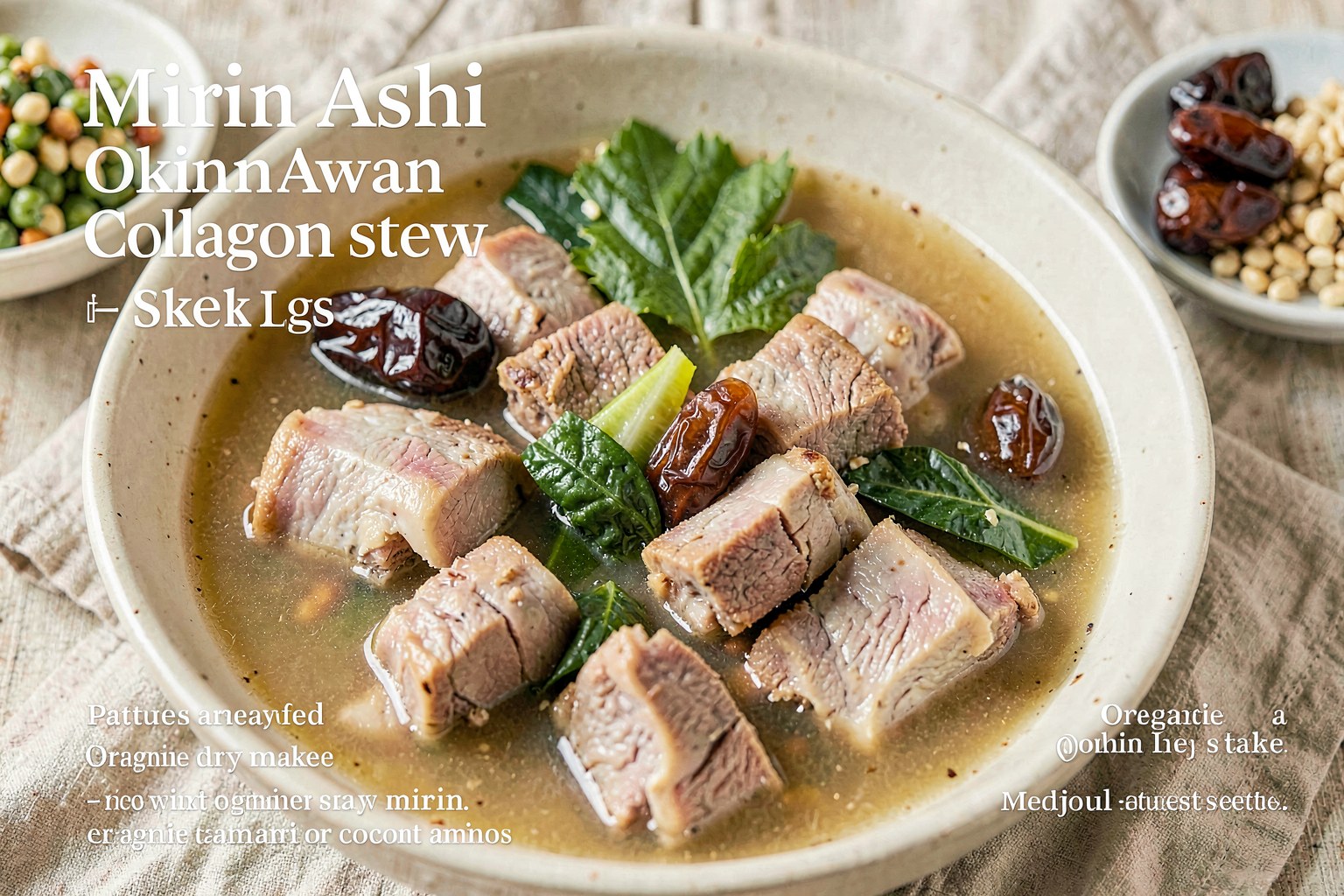
Mirin Ashi (Sake Legs) — Okinawan Collagen Stew
A nutrient-dense Okinawan classic featuring pasture-raised pork trotters slow-simmered until the connective tissue melts into a rich, gelatinous broth. The savory-sweet depth comes from traditional mirin and soy sauce, sweetened sparingly with whole dates instead of refined sugar, creating a deeply restorative dish that fuels longevity.
A little context
Mirin Ashi is a staple of the Okinawan diet, historically credited for the region's high concentration of centenarians due to its collagen-rich nature and balanced flavors. In this farm-fresh adaptation, we honor the tradition by retaining the slow-simmering technique and core flavor profile but replace the traditional refined sugar with whole dates and ensure the pork is sourced from ethical, pasture-raised farms. We avoid ultra-processed shortcuts like bouillon cubes or seed oils, relying instead on the natural gelatin and the umami depth of high-quality, organic soy sauce.
The longevity story
This dish is a powerhouse of bioavailable collagen and glycine, derived from the extensive simmering of the trotters' connective tissues, which supports joint health and gut lining integrity. The use of pasture-raised pork ensures a superior fatty acid profile compared to conventional grain-fed meat, while the fermentation in soy sauce and mirin introduces beneficial enzymes that aid digestion. Unlike the original recipe which relies on refined white sugar, this version utilizes whole dates to provide a lower glycemic load and additional polyphenols, aligning with anti-inflammatory dietary principles.
Method
- 01
Blanch the trotters
Place the split pork trotters in a large pot and cover with cold water. Bring to a rolling boil for 5 minutes to draw out impurities and scum. Drain, rinse the trotters thoroughly under cold running water, and scrub the skin to remove any remaining debris. Discard the blanching water.
- 02
Build the braising base
Return the cleaned trotters to your Dutch oven. Add the smashed ginger, chopped scallion whites, smashed garlic, pitted dates, sake, mirin, and tamari. Pour in the filtered water until the meat is just submerged.
- 03
Simmer gently
Bring the pot to a boil over high heat, then immediately reduce to the lowest possible setting. Cover with a tight-fitting lid and simmer gently for 1.5 to 2 hours. The liquid should barely bubble; this slow heat is crucial for converting collagen to gelatin.
- 04
Check for tenderness
After 90 minutes, test a trotter with a fork. The skin should be yielding and the meat should easily pull away from the bone. If it is still tough, continue simmering, checking every 15 minutes. The goal is a 'fall-off-the-bone' texture.
- 05
Strain and reduce
Once tender, carefully remove the trotters and set them aside on a warm plate. Strain the remaining broth through a fine-mesh sieve to remove the ginger, garlic, and date solids. Return the clear, gelatinous broth to the pot and simmer uncovered over medium heat for 10-15 minutes to reduce it slightly and concentrate the flavors.
- 06
Finish and serve
Return the trotters to the reduced glaze to coat them. Remove from heat and stir in the extra-virgin olive oil to preserve its polyphenols. Garnish with the reserved green scallion parts and serve warm as a rich, collagen-dense side dish.
Nutrition facts
Per serving · 1 of 4- — Saturated
- 38 g
- — Polyunsaturated
- 15 g
- Carbohydrates
- 19 g
- — Fiber
- 2 g
- — Sugars
- 14 g
- Cholesterol
- 225 mg
- Sodium
- 4901 mg
- Potassium
- 528 mg
Estimated from USDA FoodData Central for matched ingredients (60% ingredient coverage). Values vary with brand, preparation, and exact measurements.
Pro tips
- ✦Sourcing is critical: Look for pork trotters that are pink and moist, not grey or dried out. If your local butcher doesn't have them, ask them to order pasture-raised ones; the fat quality directly impacts the flavor and health profile.
- ✦The 'jiggle' test: When the dish is ready, the skin should jiggle like gelatin when you shake the pot. This indicates the collagen has fully hydrolyzed.
- ✦Don't rush the simmer: High heat will toughen the meat. Keep the flame low so the liquid is barely shivering.
- ✦Date substitution: If you cannot find Medjool dates, use 3-4 dried figs, but ensure they are unsulphured and organic.
Shop this recipe
As an Amazon Associate we earn from qualifying purchases.
Substitutions
- pasture-raised pork trotters → pasture-raised oxtail (Oxtail offers a similar collagen-rich profile and rich flavor, though the texture will be meatier and less gelatinous.)
- organic mirin → dry sake + 1 tsp maple syrup (If you cannot find sugar-free mirin, dry sake sweetened slightly with pure maple syrup works, though the flavor profile shifts slightly.)
Storage
Store in a glass container in the fridge for up to 4 days; the broth will solidify into a gel as it cools, which is a sign of high gelatin content. Freezes well for up to 3 months.
What to serve with it
- Steamed short-grain brown rice or red rice
- Blanched bitter melon (goya) with a drizzle of EVOO
- Hot green tea (sencha) or roasted barley tea (mugicha)
- Small side of fermented pickled vegetables (tsukemono)
FAQ
Why does the broth turn into a jelly when cold?+
This is a positive sign! It means the collagen from the trotters has successfully converted into gelatin, which is excellent for gut health and joint support.
Can I make this in a slow cooker?+
Yes, after blanching, transfer everything to a slow cooker and cook on LOW for 6-8 hours. The texture will be equally tender.
Is the alcohol still in the dish?+
Simmering for 1.5+ hours evaporates most of the alcohol, leaving behind the flavor compounds, which is traditional and safe for most, but if avoiding alcohol entirely, increase the water slightly and skip the sake.
Share this recipe
Notes from the community
Sign in to leave a note.
No notes yet — be the first.
You might also like