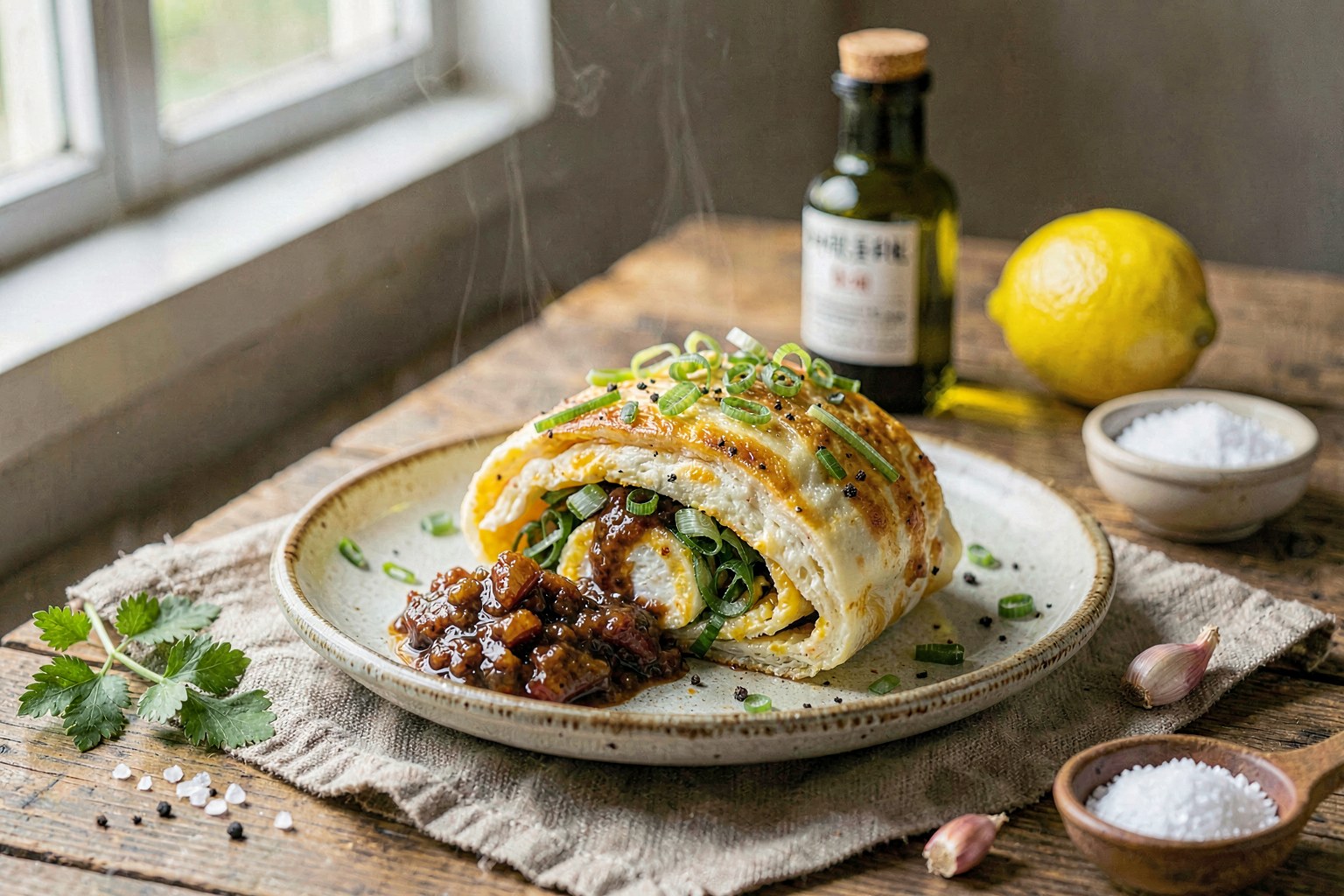
Fluffy Gyeran-mari with Fermented Ssamjang
A classic Korean rolled omelet made with pasture-raised eggs, rolled tight with crisp scallions and savory umami, served with a homemade fermented ssamjang. This dish delivers sustained energy through high-quality protein and healthy fats, completely free of refined sugar and seed oils.
A little context
Gyeran-mari is a staple of the Korean banchan table, traditionally served alongside rice and soup for a balanced breakfast. While traditional recipes often call for a teaspoon of sugar to balance the saltiness of the soy sauce, we have omitted it entirely, relying on the natural sweetness of the scallions and the depth of the fermented paste. By swapping seed oils for extra-virgin olive oil and using only organic, pasture-raised eggs, we honor the spirit of the dish while adhering to modern longevity standards.
The longevity story
The foundation of this dish is the pasture-raised egg, providing choline for cognitive function and a complete amino acid profile without the inflammatory load of grain-fed poultry. We rely on extra-virgin olive oil for its oleocanthal content, a potent polyphenol with anti-inflammatory properties similar to ibuprofen, to cook the eggs. The homemade ssamjang introduces fermented doenjang (soybean paste), which offers probiotics for gut health and isoflavones that support metabolic resilience, replacing the high-fructose corn syrup often found in commercial versions.
Method
- 01
Prepare the aromatics
In a small bowl, combine the minced garlic, sea salt, and black pepper. Let sit for 5 minutes to allow the allicin to activate. Whisk the eggs vigorously until completely homogeneous; the mixture should be uniform yellow with no streaks of white. Fold in the sliced scallions and half of the extra-virgin olive oil.
- 02
Heat the pan
Place your tamagoyaki pan or small skillet over medium-low heat. Add 1/3 of the remaining olive oil. The oil is ready when it shimmers but does not smoke. If using a non-stick pan, ensure it is well-seasoned to prevent sticking.
- 03
First layer
Pour in roughly one-third of the egg mixture, tilting the pan to cover the entire bottom surface. Let it set for about 45 seconds until the edges are firm but the top is still slightly runny. Use your spatula to gently lift the edges and tuck them under, ensuring a tight seal.
- 04
First roll
Starting from the far end of the pan, carefully roll the egg layer toward you into a tight cylinder. Push the rolled egg to the far end of the pan, leaving the near side open.
- 05
Add oil and second layer
Add a small drizzle of the remaining olive oil to the empty side of the pan. Pour in another third of the egg mixture, tilting the pan to let the liquid flow underneath the existing roll. Lift the roll gently with your spatula to allow the raw egg to seal underneath it.
- 06
Second roll
Once the new layer is set but still slightly moist on top, roll the existing cylinder forward over the new layer. Repeat this process until the final third of the egg mixture is added, ensuring the layers are compact.
- 07
Shape and finish
Once all egg is incorporated, gently press the roll against the sides of the pan to square off the shape. Cook for another 30 seconds to ensure the interior is fully set but not dry. Remove from heat and transfer to a cutting board.
- 08
Make the ssamjang
While the egg rests, combine the doenjang, sugar-free gochujang, toasted sesame oil, and the garlic-salt paste in a small bowl. Mix until smooth. Taste and adjust with a drop of maple syrup only if absolutely necessary for balance, though the fermented paste should provide sufficient depth.
- 09
Slice and serve
Allow the egg roll to cool for 2 minutes, then slice into 1.5 cm (1/2 inch) thick rounds. Arrange on a plate with a dollop of the homemade ssamjang. Serve immediately with fresh kimchi or a side of steamed greens.
Nutrition facts
Per serving · 1 of 4- — Saturated
- 1 g
- — Polyunsaturated
- 1 g
- Carbohydrates
- 4 g
- — Fiber
- 1 g
- — Sugars
- 2 g
- Cholesterol
- 0 mg
- Sodium
- 487 mg
- Potassium
- 55 mg
Estimated from USDA FoodData Central for matched ingredients (44% ingredient coverage). Values vary with brand, preparation, and exact measurements.
Pro tips
- ✦Source your eggs specifically labeled 'pasture-raised' to ensure higher Omega-3s and Vitamin D; the yolks should be a deep, vibrant orange.
- ✦Maintain low-to-medium heat; high heat will make the egg rubbery and prevent the delicate rolling process.
- ✦If your egg mixture seems too thick to pour easily, whisk in 1 teaspoon of water or broth to loosen it slightly.
- ✦For the ssamjang, ensure your gochujang is the traditional fermented kind without added corn syrup or sugar; many commercial brands hide sugar in the ingredients list.
- ✦Use a flexible silicone spatula for rolling; a metal spatula can easily tear the thin egg layers.
Shop this recipe
As an Amazon Associate we earn from qualifying purchases.
Substitutions
- scallions → thinly sliced spinach or chives (spinach must be wilted and squeezed dry before adding to prevent sogginess)
- doenjang → white miso paste (use a high-quality, unpasteurized white miso for similar fermentation benefits)
- gochujang → fresh red chili flakes and a dash of rice vinegar (adds heat without the sugar content of commercial pastes)
Storage
Cool completely and store in an airtight glass container in the refrigerator for up to 3 days. The ssamjang can be stored separately for up to 1 week. Do not freeze the rolled eggs as the texture will become rubbery upon thawing.
What to serve with it
- Hot green tea (matcha or sencha) for a polyphenol boost
- Fresh kimchi (fermented) for gut health synergy
- Steamed brown rice or quinoa if a grain is desired
- Sparkling water with a wedge of lemon
FAQ
Why is the traditional recipe sweetened?+
Traditional Korean cooking often uses a small amount of sugar to balance the intense saltiness of soy sauce and fermented pastes. We omit this to avoid blood sugar spikes, relying on the natural sweetness of the scallions and the depth of fermentation instead.
Can I make this gluten-free?+
Yes, provided you use certified gluten-free doenjang and gochujang, as some brands may use wheat barley as a filler. Always check the label.
What if I don't have a rectangular pan?+
A small (15 cm/6 inch) non-stick skillet works well. You may need to be slightly more careful with the rolling, but the result will be a rounder, rustic omelet that tastes just as good.
Share this recipe
Notes from the community
Sign in to leave a note.
No notes yet — be the first.
You might also like