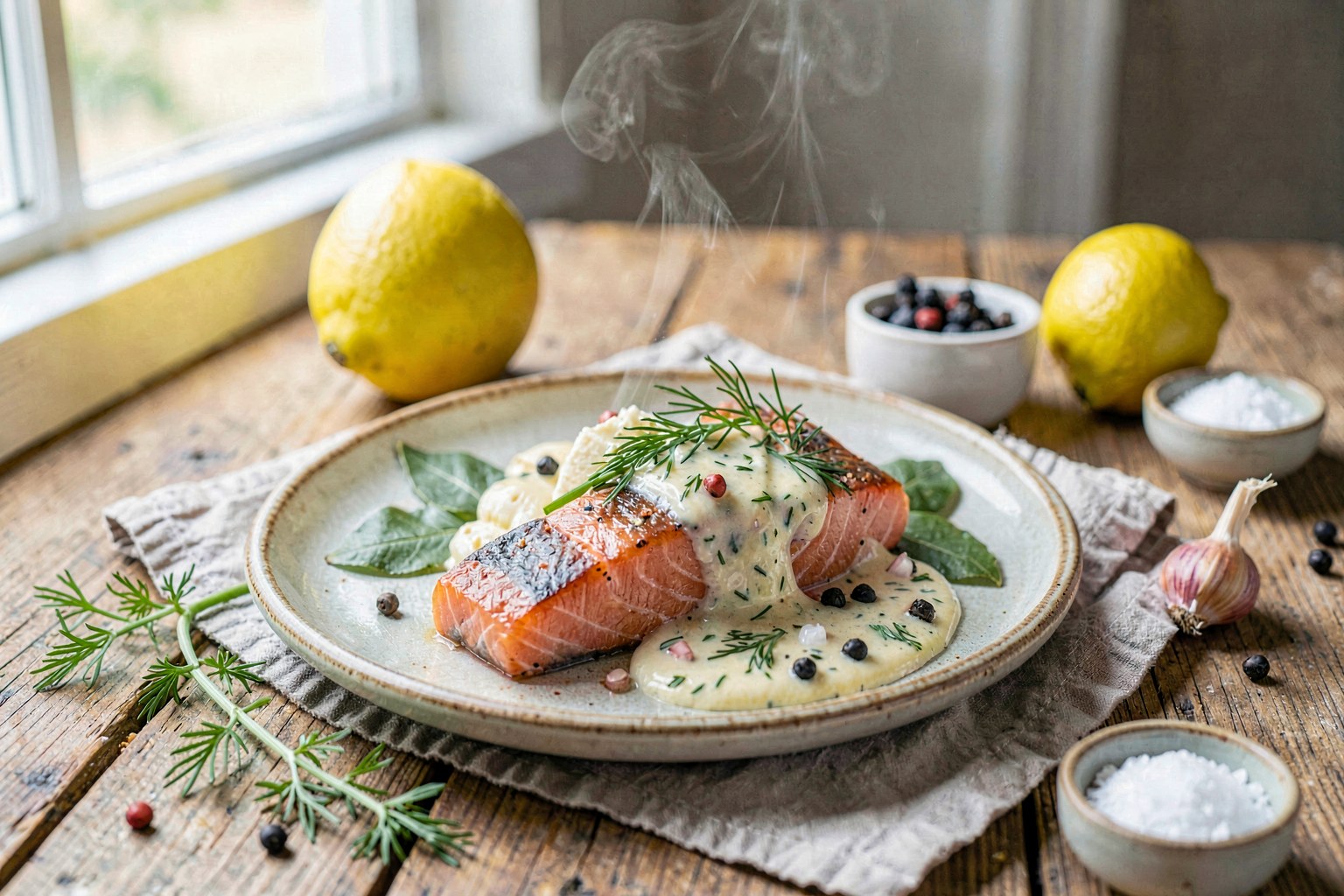
Nordic Dill Sauce with Wild-Caught Salmon
A bright, emulsified sauce of grass-fed butter, fresh dill, and shallots, designed to elevate cold-poached wild salmon. This dish captures the essence of Nordic simplicity, replacing traditional sugar and seed oils with the natural sweetness of shallots and the clean fat of pasture-raised butter. The result is a rich, herbaceous accompaniment that honors the fish without masking its delicate, oceanic flavor.
A little context
Rooted in the Scandinavian tradition of 'gravlax' and cold fish service, this recipe strips away the modern addition of granulated sugar and industrial seed oils often found in contemporary interpretations. Instead, we rely on the natural sweetness of slow-cooked shallots and the integrity of grass-fed butter to create a creamy texture. This approach respects the Nordic philosophy of 'clean eating' by using only ingredients that could be sourced from a local farm or the sea.
The longevity story
This recipe leverages the high omega-3 fatty acid content of wild-caught sockeye salmon to support cellular membrane health and reduce systemic inflammation. The sauce utilizes grass-fed butter, which provides conjugated linoleic acid (CLA) and fat-soluble vitamins A, D, and K2, while fresh dill contributes potent polyphenols like apigenin and quercetin. Shallots and vinegar offer prebiotic fibers and acetic acid, respectively, aiding in blood sugar regulation and gut microbiome diversity. By eliminating refined sugars and seed oils, we prevent the oxidative stress often associated with traditional cream sauces.
Method
- 01
Prepare the poaching bath
In a wide, shallow pan, combine 2 L of filtered water, coarse sea salt, crushed white peppercorns, bay leaves, and dill stems. Bring to a gentle simmer, then remove from heat. The water should be barely shivering, not boiling, to ensure the fish remains tender.
- 02
Poach the salmon
Pat the wild-caught salmon fillet dry and lower it skin-side down into the warm liquid. Cover the pan and let it steep off the heat until the internal temperature reaches 50°C (122°F), approximately 12–15 minutes depending on thickness. The flesh should be opaque on the outside but still slightly translucent in the very center.
- 03
Cool and chill
Using a slotted spatula, carefully remove the salmon. Place it on a wire rack over a baking sheet to cool to room temperature, then refrigerate uncovered for at least 30 minutes. This step firms the flesh and makes it easier to slice.
- 04
Reduce the vinegar base
While the fish chills, combine the minced shallots, white wine vinegar, and 120 ml of filtered water in a small heavy-bottomed saucepan. Simmer over medium heat until the liquid has reduced by half, concentrating the flavor to about 60 ml. This should take 8–10 minutes; the shallots should be soft but not browned.
- 05
Emulsify the butter
Reduce the heat to the lowest setting. Whisk in the cold, cubed grass-fed butter one piece at a time, allowing each cube to melt and fully emulsify before adding the next. The sauce should thicken and become glossy. Do not let the sauce boil, or the butter will separate.
- 06
Finish the sauce
Remove the sauce from the heat. Stir in the finely chopped fresh dill, sea salt, and white pepper. Taste and adjust seasoning; the sauce should be bright and tangy. If it becomes too thick, whisk in a teaspoon of warm water to loosen it.
- 07
Serve
Slice the chilled salmon into thick portions. Drizzle generously with the warm dill sauce or serve it on the side. Garnish with additional fresh dill sprigs and serve immediately.
Nutrition facts
Per serving · 1 of 4- — Saturated
- 9 g
- — Polyunsaturated
- 2 g
- Carbohydrates
- 3 g
- — Fiber
- 1 g
- — Sugars
- 1 g
- Cholesterol
- 90 mg
- Sodium
- 1841 mg
- Potassium
- 533 mg
Estimated from USDA FoodData Central for matched ingredients (77% ingredient coverage). Values vary with brand, preparation, and exact measurements.
Pro tips
- ✦Source your dill from a local farm or grow it yourself; the polyphenol content drops significantly after a few days of harvest.
- ✦For the best emulsion, ensure your butter is very cold and your reduction is hot but not boiling when you start whisking.
- ✦Do not overcook the salmon; the Nordic tradition relies on the fish being just set, preserving the delicate omega-3s and texture.
- ✦If you cannot find white wine vinegar, organic apple cider vinegar is an excellent substitute that maintains the acidity profile without added sugar.
Shop this recipe
As an Amazon Associate we earn from qualifying purchases.
Substitutions
- wild-caught sockeye salmon → wild-caught Arctic char or rainbow trout (Arctic char has a similar fat profile and texture, making it an ideal sustainable alternative.)
- grass-fed butter → ghee (Use ghee for a dairy-free version, though the flavor will be less creamy and more nutty.)
Storage
Store the salmon and sauce separately in airtight glass containers in the refrigerator for up to 3 days. Do not freeze the sauce as the emulsion may break upon thawing; the fish can be frozen for up to 2 months if tightly wrapped.
What to serve with it
- Steamed asparagus with a squeeze of lemon
- Simple cucumber and radish salad with sea salt
- Unsweetened green tea or sparkling water with a slice of lemon
- A dry, mineral-forward white wine like a Norwegian Aquavit or a crisp Riesling
FAQ
Can I use farmed salmon?+
Farmed salmon often has a higher ratio of omega-6 to omega-3 fatty acids due to grain-based feed, and may contain artificial dyes. Wild-caught is preferred for the superior nutritional profile and cleaner taste.
Why do we reduce the vinegar before adding butter?+
Reducing the vinegar concentrates the flavor and removes the harsh alcohol notes, creating a stable base that emulsifies more easily with the butter fat.
Share this recipe
Notes from the community
Sign in to leave a note.
No notes yet — be the first.
You might also like