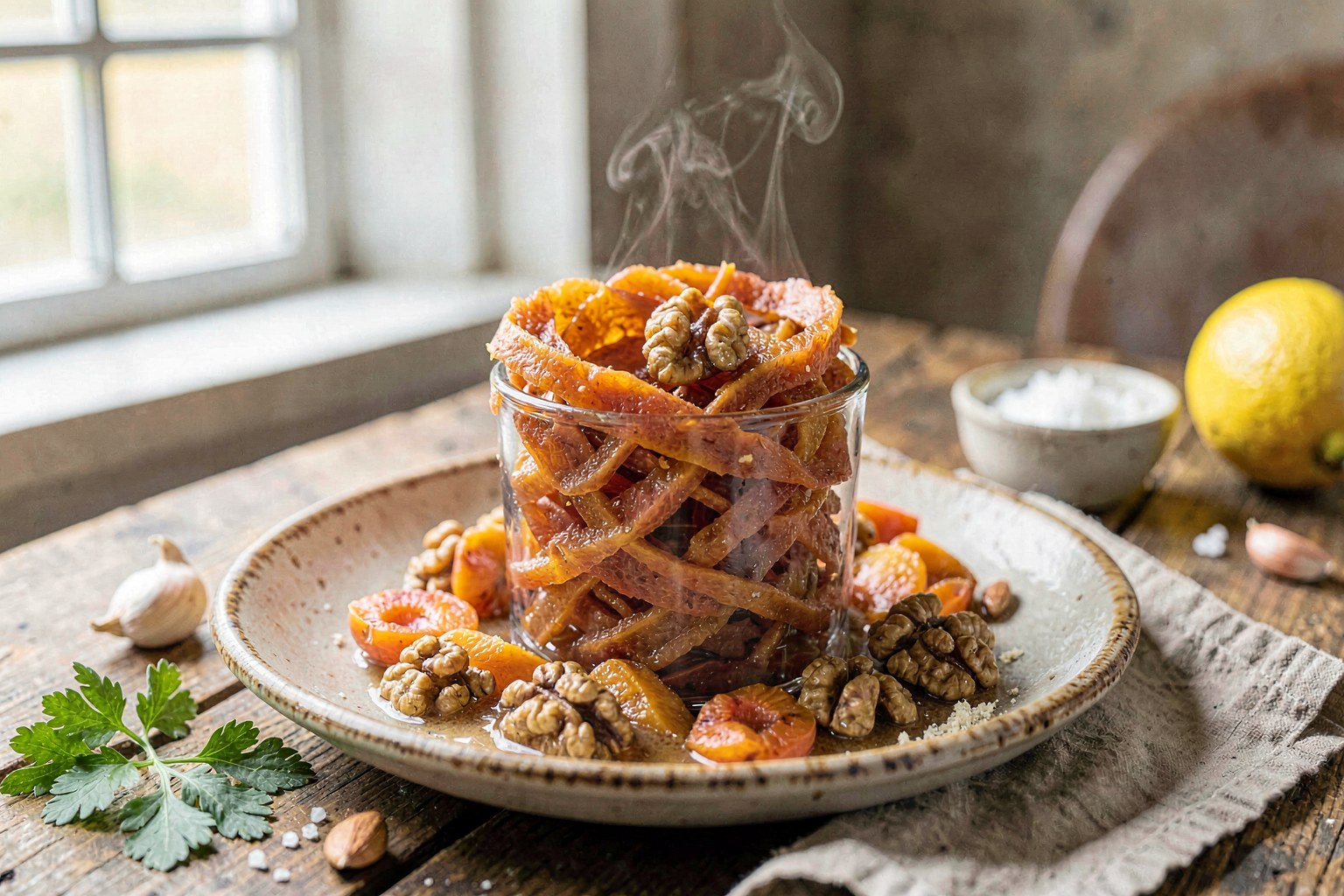
Ancient Georgian Churchkhela: Apricot & Walnut Candles
These chewy, sun-dried strands are a modernized take on the Georgian Supra tradition, replacing refined sugar with the natural sweetness of ripe apricots and thickening the broth with nutrient-dense almond flour instead of white starch. The result is a fiber-rich, polyphenol-packed treat that honors the 'candle' aesthetic while delivering sustained energy from healthy fats and whole fruit.
A little context
Churchkhela is a centerpiece of the Georgian Supra (feast), historically made by dipping nut-filled strings into a boiled grape or pomegranate juice thickened with flour. We honor this heritage by keeping the slow-cooking process and the nut-filled core but swap the grape juice for apricot (a traditional alternative in the Caucasus) and replace white flour with almond flour to eliminate refined carbohydrates. This adaptation preserves the communal spirit of the dish while adhering to a clean, anti-inflammatory dietary framework.
The longevity story
This recipe leverages the synergistic effect of monounsaturated fats from walnuts and the antioxidant capacity of apricots, which are rich in beta-carotene and polyphenols. By thickening the fruit syrup with almond flour instead of refined wheat starch, we maintain a lower glycemic load while adding plant-based protein and vitamin E. The absence of seed oils and refined sugars prevents the inflammatory spikes often associated with traditional confectionery, making this a true longevity snack.
Method
- 01
Prepare the Fruit Broth
Place the pitted apricots and 120 ml (½ cup) of water in a high-speed blender. Blend on high until completely smooth, about 2-3 minutes. Pour the mixture through a fine-mesh sieve into a heavy-bottomed saucepan, pressing with a wooden spoon to extract all the liquid and discard the fibrous skins.
- 02
Thicken the Syrup
Place the saucepan over medium-low heat. Whisk in the almond flour and cinnamon. Stir continuously. The mixture will thicken rapidly as it warms; keep stirring for 10-15 minutes until it reaches the consistency of a thick pancake batter or honey. It should coat the back of the spoon heavily.
- 03
Test the Consistency
To test, dip a spoon into the syrup and let it cool for 30 seconds. If it forms a soft, chewy film that doesn't run off immediately, it is ready. If it is too runny, continue cooking for another 5 minutes, stirring constantly to prevent burning. The goal is a thick, glossy glaze.
- 04
Thread the Walnuts
While the syrup simmers, thread 4-5 walnut halves onto each length of cotton twine. Tie a knot at the top of each string to create a loop for hanging. Ensure the nuts are spaced evenly but snugly against each other.
- 05
Dip and Coat
Reduce the heat to the lowest setting to keep the syrup warm but not boiling. Submerge a string of walnuts into the hot syrup, ensuring full coverage. Lift it out and let the excess drip back into the pot for 10 seconds. Place the coated string on a wire rack or a clean wooden board lined with parchment paper.
- 06
Repeat the Layers
Allow the first layer to cool for 10-15 minutes until tacky but not wet. Repeat the dipping process 2-3 more times. Each layer adds thickness and chewiness. The final texture should be firm enough to hold its shape but soft enough to bite into.
- 07
Final Drying
Once the final coat is applied, hang the Churchkhela in a cool, dry, well-ventilated area (away from direct sunlight) for 24-48 hours. They are ready when the exterior is dry to the touch and slightly firm, but the interior remains chewy.
Nutrition facts
Per serving · 1 of 4- — Saturated
- 3 g
- — Polyunsaturated
- 24 g
- Carbohydrates
- 27 g
- — Fiber
- 6 g
- — Sugars
- 13 g
- Cholesterol
- 0 mg
- Sodium
- 2 mg
- Potassium
- 545 mg
Estimated from USDA FoodData Central for matched ingredients (50% ingredient coverage). Values vary with brand, preparation, and exact measurements.
Pro tips
- ✦Sourcing is key: Look for raw, organic walnuts with no rancid smell; they should feel heavy for their size.
- ✦Temperature control: If the syrup cools and hardens in the pot, gently reheat it with a splash of water; do not boil it again as it may become too hard.
- ✦Humidity check: Do not attempt to dry these on a humid day, as they will remain sticky and may mold; use a dehydrator on the 'warm' setting (40°C/104°F) if your climate is humid.
- ✦Texture test: The syrup is ready when a drop placed in cold water forms a soft ball that can be flattened between your fingers.
Substitutions
- apricots → pomegranate juice (100% pure, no added sugar) (Traditional Georgian flavor profile; may require slightly more almond flour to thicken.)
- walnuts → hazelnuts or almonds (Hazelnuts offer a different fat profile and flavor; almonds provide a firmer core.)
- almond flour → chestnut flour (A traditional thickener in some regions; adds a slightly sweeter, earthier flavor.)
Storage
Store in an airtight glass container at room temperature for up to 2 weeks, or refrigerate for up to 1 month. They can be frozen for up to 3 months; thaw at room temperature before serving.
What to serve with it
- Green tea (sencha or matcha) to complement the earthy walnuts
- Sparkling water with a twist of lemon or orange
- A dry Georgian red wine like Saperavi (if alcohol is part of your protocol)
- Fresh figs or a small handful of berries
FAQ
Can I use regular flour instead of almond flour?+
No. Traditional recipes use white flour, but for a Blueprint-aligned version, we use almond flour to avoid the glycemic spike and gluten. White flour would make the texture gummy and the nutrition profile poor.
Why does my syrup turn hard like candy?+
You likely cooked it too long or the heat was too high. The syrup should thicken via evaporation of water, not caramelization of sugars. Keep the heat low and stir constantly.
Are these suitable for a strict low-carb diet?+
They are lower glycemic than traditional versions due to the lack of refined sugar and white flour, but apricots and walnuts do contain natural sugars and carbs. They are best enjoyed as a small, nutrient-dense treat rather than a staple.
Share this recipe
Notes from the community
Sign in to leave a note.
No notes yet — be the first.
You might also like