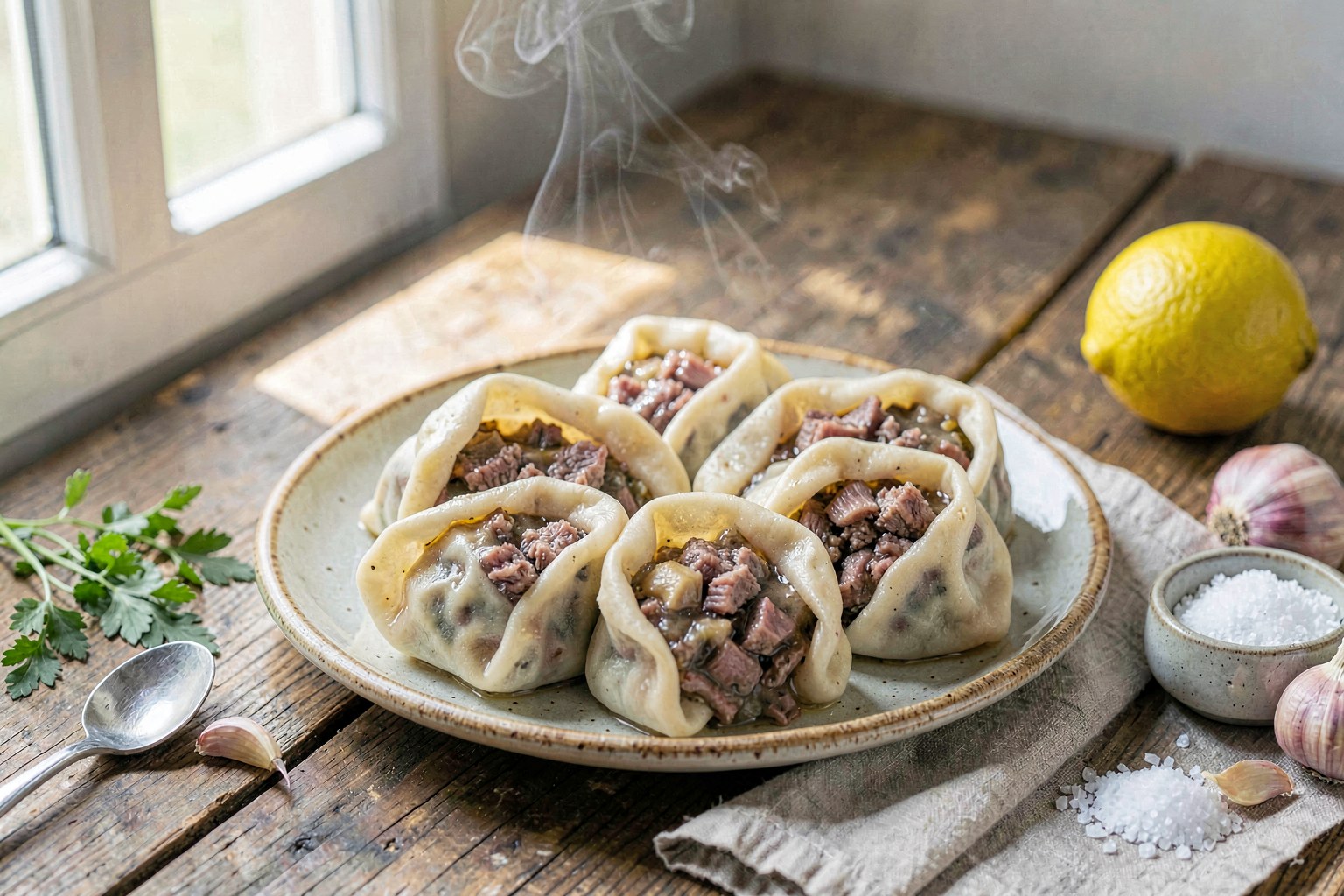
Georgian Khinkali with Grass-Fed Beef & Pastured Pork
These large, hand-folded dumplings feature a savory broth-filled center made from a blend of grass-fed beef and pastured pork, encased in a springy, wheat-alkaline dough. Served piping hot with a sharp garlic-vinegar dip and a fresh herb salad, this dish honors the Georgian Supra tradition while strictly adhering to clean, unrefined fat and sugar protocols.
A little context
Khinkali is the centerpiece of the Georgian Supra, a communal feast where the top-knot (kudi) is traditionally left on the plate as a tally of how many dumplings one has eaten. In this version, we honor the tradition of hand-folding and the communal eating style but eliminate the refined white flour and any added sugar sometimes found in commercial doughs. We also strictly avoid seed oils often used in modern adaptations, replacing them with stable, nutrient-dense animal fats and olive oil to maintain the dish's structural integrity and nutritional profile.
The longevity story
The filling relies on grass-fed beef and pastured pork, which provide a superior omega-3 to omega-6 fatty acid ratio and higher levels of conjugated linoleic acid (CLA) compared to grain-fed counterparts. The dough is made with spelt flour, offering a more digestible gluten structure and higher mineral content than refined white flour. We utilize extra-virgin olive oil in the filling to introduce polyphenols like oleocanthal, while the accompanying garlic and fresh herbs (coriander, tarragon) deliver potent anti-inflammatory compounds and prebiotic fibers to support gut health.
Method
- 01
Activate the dough
In a large bowl or stand mixer, combine the spelt flour and salt. Gradually add the warm water while mixing on low speed (or stirring with a wooden spoon) until a shaggy mass forms. Knead for 8-10 minutes by machine or 12-15 minutes by hand until the dough is smooth, elastic, and no longer sticky. If too sticky, add a dusting of flour; if too dry, add water 1 tsp at a time.
- 02
Rest the dough
Wrap the dough tightly in plastic wrap or cover with a damp cloth. Let it rest at room temperature for 30-45 minutes. This relaxes the gluten, making it pliable enough to stretch thin without tearing.
- 03
Prepare the filling
In a large bowl, combine the ground grass-fed beef, pastured pork, minced onion, garlic, chopped cilantro, tarragon, salt, pepper, and extra-virgin olive oil. Mix vigorously by hand for 2-3 minutes. The friction and mixing will help the proteins bind. Slowly pour in the cold broth while continuing to mix until the liquid is fully absorbed and the mixture is slightly sticky. Cover and refrigerate for at least 20 minutes.
- 04
Roll the wrappers
Divide the rested dough into 12-14 equal balls. On a lightly floured surface, roll each ball into a circle approximately 12-13 cm (5 inches) in diameter. The center should be slightly thicker than the edges. The dough must be thin enough to be translucent but strong enough to hold the broth.
- 05
Fill and pleat
Place 1 heaping tablespoon of filling (approx. 35-40g) in the center of a wrapper. Holding the edges, begin pleating the dough in a spiral motion, twisting the top into a tight knot (kudi). Ensure the pleats are tight and the bottom is sealed well to prevent broth leakage. The top knot can be left on or pinched off before cooking, but the traditional way is to leave it on.
- 06
Boil the water
Fill a large pot with water, add a generous pinch of salt, and bring to a rolling boil. Reduce heat slightly to a vigorous simmer to prevent the dumplings from breaking upon impact.
- 07
Cook the Khinkali
Gently drop 6-8 dumplings into the water (do not overcrowd). Stir gently once to prevent sticking. Cover and cook for 10-12 minutes. The dough will turn slightly translucent, and the meat will be cooked through. Remove with a slotted spoon.
- 08
Prepare the dip
While the dumplings cook, combine the raw apple cider vinegar and crushed garlic in a small bowl. Let it sit for 5 minutes to infuse the garlic flavor.
- 09
Serve immediately
Serve the Khinkali hot on a large platter. Instruct diners to hold the dumpling by the top knot, take a small bite to sip the hot broth, then eat the rest. Discard the top knot on the plate. Serve with the garlic vinegar dip and a side of fresh herbs.
Nutrition facts
Per serving · 1 of 4- — Saturated
- 11 g
- — Polyunsaturated
- 5 g
- Carbohydrates
- 35 g
- — Fiber
- 7 g
- — Sugars
- 2 g
- Cholesterol
- 89 mg
- Sodium
- 2291 mg
- Potassium
- 823 mg
Estimated from USDA FoodData Central for matched ingredients (73% ingredient coverage). Values vary with brand, preparation, and exact measurements.
Pro tips
- ✦The broth is the soul of the dish; do not skip the step of mixing the cold liquid into the meat, as it creates the steam that cooks the meat from the inside.
- ✦When rolling the dough, the thinner the better, but if it tears, patch it with a tiny scrap of dough and water.
- ✦Sourcing tip: Look for pork labeled 'pasture-raised' or 'heritage breed' to ensure a better flavor profile and higher omega-3 content compared to standard commercial pork.
- ✦Do not overfill the dumplings; if the meat expands too much, the dough will burst. 35-40g of filling per dumpling is the sweet spot.
- ✦If you cannot eat gluten, this recipe does not translate well to gluten-free flours as the elasticity is required for the pleating; consider a different dumpling style for GF needs.
Shop this recipe
As an Amazon Associate we earn from qualifying purchases.
Substitutions
- spelt flour → organic all-purpose flour or einkorn flour (einkorn is an ancient grain with lower gluten content and better digestibility; all-purpose works but lacks the mineral profile of spelt.)
- pastured pork → grass-fed lamb (lamb is traditional in some Georgian regions and pairs beautifully with the herbs, though it has a stronger flavor.)
- apple cider vinegar → red wine vinegar (red wine vinegar adds a deeper, fruitier acidity that works well with the red meat.)
Storage
Uncooked dumplings can be frozen on a baking sheet, then transferred to a freezer bag for up to 2 months. Cook from frozen, adding 2-3 minutes to the boiling time. Cooked dumplings are best eaten immediately but can be refrigerated in a single layer for 1 day; reheat by steaming, not microwaving, to preserve texture.
What to serve with it
- Dry Georgian red wine (Saperavi) or a glass of sparkling water with a wedge of lemon
- Fresh green salad with radishes and extra-virgin olive oil
- Unsweetened green tea or herbal tea with mint
FAQ
Can I use lean ground beef to reduce fat?+
No. The fat is essential for the juiciness and the broth formation. Lean beef will result in a dry, tough dumpling. Grass-fed beef has a better fat quality profile than lean grain-fed beef.
Why do I need to rest the dough?+
Resting relaxes the gluten strands. Without this step, the dough will snap back when you try to roll it thin, making it impossible to pleat properly.
Is the top knot edible?+
Traditionally, the top knot is tough and chewy. It is used as a handle to hold the dumpling and is discarded on the plate. Some people eat it, but it is not the primary part of the experience.
Share this recipe
Notes from the community
Sign in to leave a note.
No notes yet — be the first.
You might also like