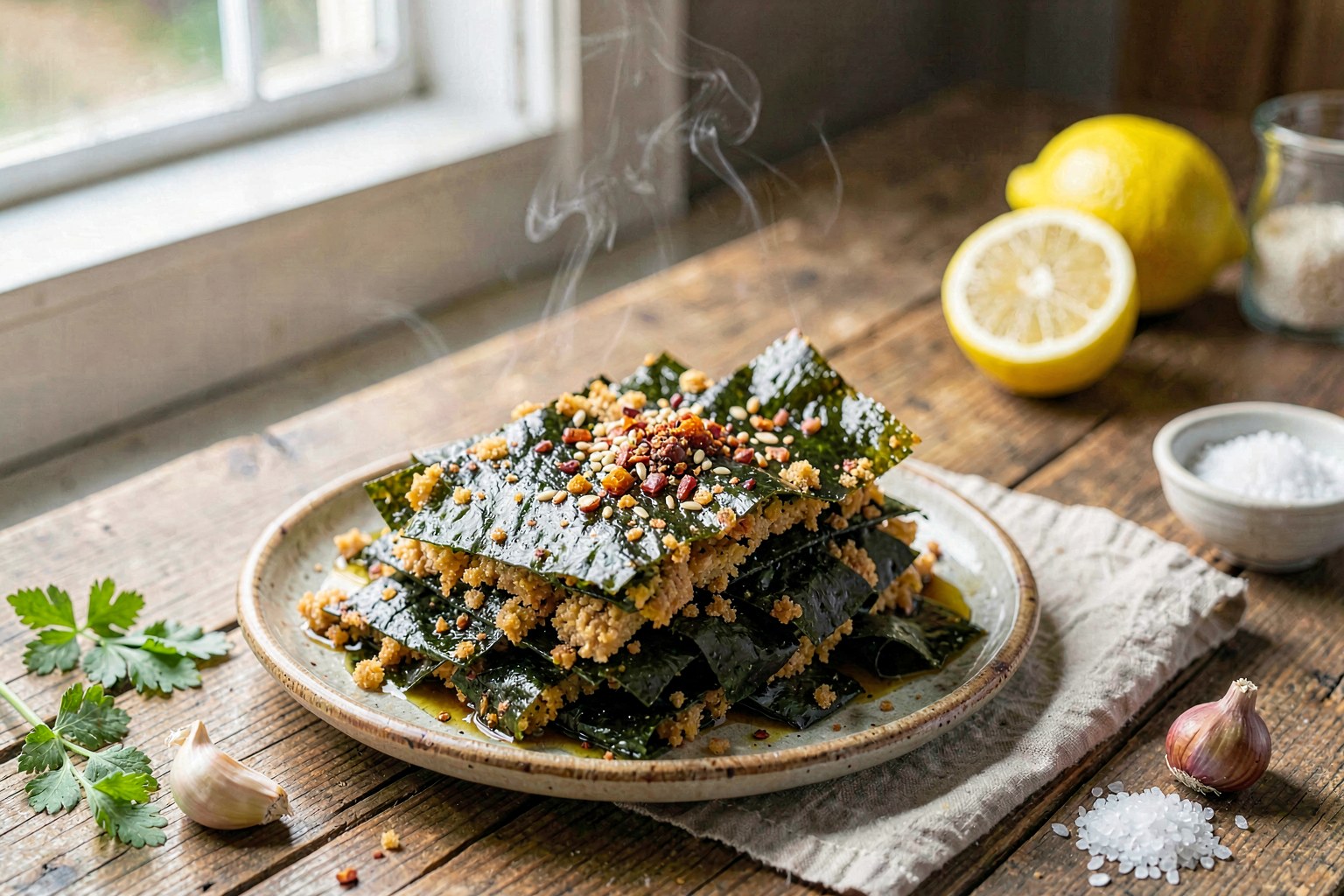
Crispy Gim Chae with Spicy Avocado Oil & Toasted Sesame
This version of Gim Chae transforms humble dried seaweed sheets into a crunchy, savory banchan by toasting them to a crisp and tossing with a spicy, nutrient-dense oil infusion. Unlike traditional versions that rely on refined sugar and seed oils, this recipe uses a touch of date syrup for balance and high-heat stable avocado oil to preserve the seaweed's delicate texture and mineral content.
A little context
In Korean tradition, Gim is a daily staple often seasoned with salt, sesame oil, and sugar to create a savory-sweet crunch. We honor this ancient practice by keeping the core technique of toasting and seasoning but swapping refined sugar for a minimal amount of date syrup to avoid blood sugar spikes, and replacing seed oils with cold-pressed avocado oil. This adaptation respects the original flavor profile while aligning with a longevity-focused, whole-foods approach that prioritizes clean fats and unrefined sweeteners.
The longevity story
The star ingredient, dried laver (gim), is a powerhouse of iodine, magnesium, and bioavailable B12, essential for thyroid function and metabolic longevity. The fucoidan and alginate fibers in the seaweed act as prebiotics, supporting a healthy gut microbiome, while the capsaicin in the red chili flakes provides anti-inflammatory benefits and thermogenic support. We utilize extra-virgin avocado oil for its high monounsaturated fat stability and polyphenol content, avoiding the oxidative stress caused by traditional seed oils like canola or soybean.
Method
- 01
Prepare the Seaweed
Take the dried laver sheets and cut them into uniform 2.5 cm (1 inch) strips using kitchen shears or a sharp knife. Spread them out on a clean kitchen towel to ensure they are completely dry; any moisture will steam the seaweed rather than toast it.
- 02
Infuse the Oil
In a small saucepan over low heat, combine the avocado oil, minced garlic, and Gochugaru. Heat gently for 3-4 minutes until the garlic is fragrant but not browned. Remove from heat immediately and let the oil steep for 10 minutes to extract the capsaicin and garlic compounds.
- 03
Toast the Seaweed
Place the heavy skillet over medium-low heat. Add the seaweed strips in a single layer. Toast for 30-45 seconds per side, flipping carefully with tongs, until they turn a brighter green and become crisp. Do not burn them; they should shatter when touched.
- 04
Combine and Season
Transfer the toasted seaweed to a large mixing bowl. Pour the infused oil (including the garlic and chili flakes) over the strips. Add the date syrup and sea salt. Toss immediately and vigorously with tongs until every strip is evenly coated and glossy.
- 05
Finish and Serve
Sprinkle the toasted black sesame seeds over the top and give one final gentle toss. Serve immediately while the seaweed is at its crispest. If making ahead, store the oil and seaweed separately and combine just before serving to maintain crunch.
Nutrition facts
Per serving · 1 of 4- — Saturated
- 1 g
- — Polyunsaturated
- 2 g
- Carbohydrates
- 4 g
- — Fiber
- 1 g
- — Sugars
- 2 g
- Cholesterol
- 0 mg
- Sodium
- 971 mg
- Potassium
- 52 mg
Estimated from USDA FoodData Central for matched ingredients (43% ingredient coverage). Values vary with brand, preparation, and exact measurements.
Pro tips
- ✦Source your Gochugaru directly from Korean markets to ensure it is free from added corn syrup or seed oil, which are common in mass-market brands.
- ✦When toasting the seaweed, keep the heat low; high heat will turn the delicate algae bitter and lose its vibrant green color.
- ✦The date syrup can be sticky; warm it slightly in the microwave for 10 seconds before adding to ensure it coats the oil evenly.
- ✦For maximum polyphenol retention, use the oil infusion within 24 hours of making it, as capsaicin and garlic compounds degrade over time in oil.
Shop this recipe
As an Amazon Associate we earn from qualifying purchases.
Substitutions
- date syrup → pure maple syrup or monk fruit syrup (Use sparingly if substituting maple syrup to maintain low-glycemic goals; monk fruit is zero-glycemic.)
- avocado oil → extra-virgin olive oil (Only use high-quality EVOO if keeping the heat very low to prevent oxidation; avocado oil is preferred for higher heat stability.)
Storage
Store the seasoned Gim Chae in an airtight glass container in the refrigerator for up to 3 days. Note that the seaweed may lose some crunch over time; re-crisp in a dry pan for 30 seconds before serving. The oil infusion alone can be stored for up to 5 days.
What to serve with it
- Serve alongside a bowl of warm brown rice or quinoa
- Pair with a large green salad dressed with lemon and EVOO
- Accompany with a cup of hot green tea or hibiscus tea to aid digestion
FAQ
Why not use sesame oil for the toasting?+
Traditional sesame oil has a low smoke point and can oxidize easily at toasting temperatures, creating harmful compounds. We use avocado oil for the cooking process and rely on the sesame seeds for the nutty flavor and crunch.
Can I make this spicy?+
Yes, increase the Gochugaru to 2 tablespoons or add a pinch of cayenne pepper for extra heat without adding sugar.
Share this recipe
Notes from the community
Sign in to leave a note.
No notes yet — be the first.
You might also like