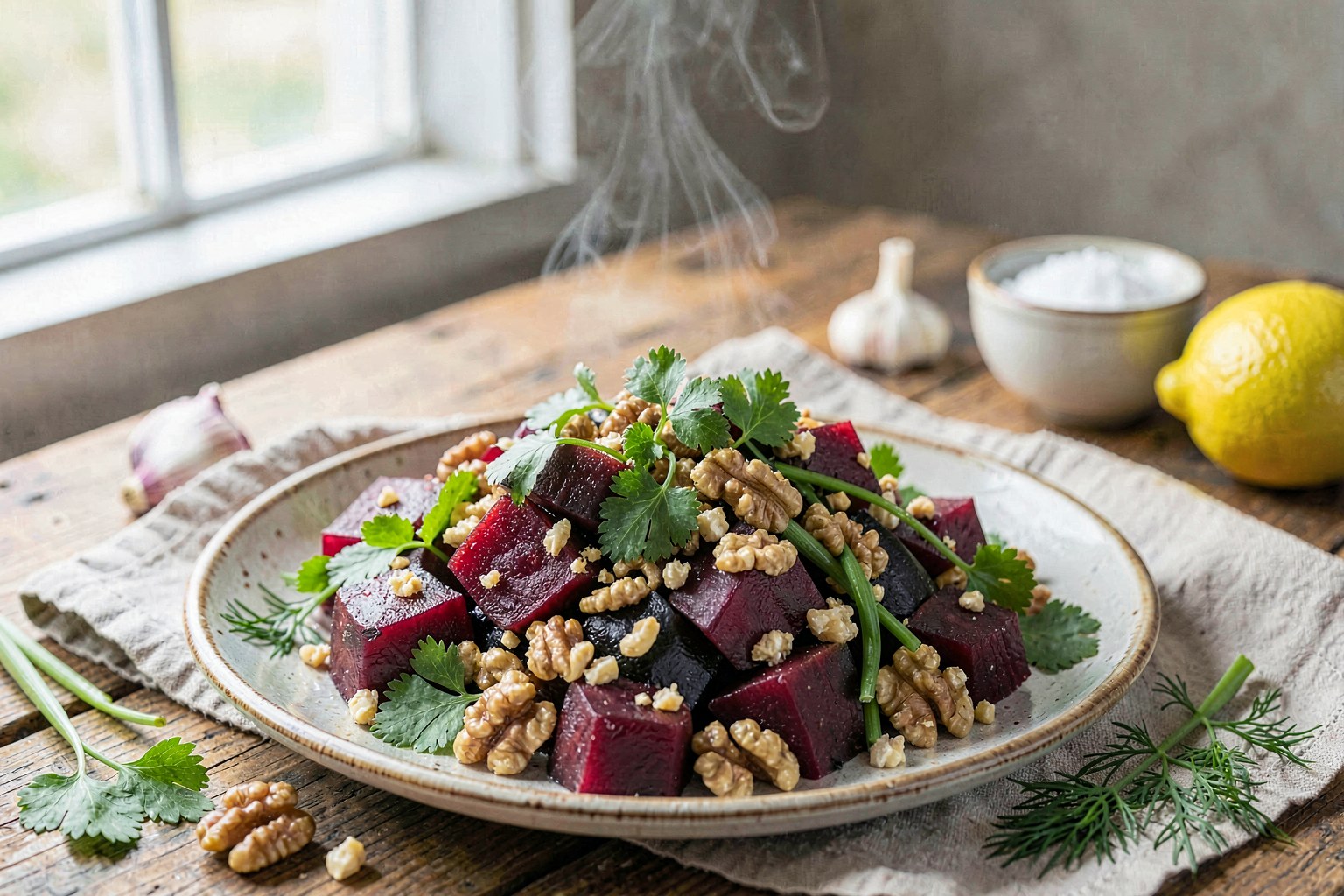
Roasted Beetroot & Walnut Pkhali (Georgian Supra Tradition)
A vibrant, earthy spread featuring roasted organic beets bound with crushed raw walnuts, fresh coriander, and pungent garlic. This dish delivers a savory, umami-rich texture without refined fats or sugars, honoring the Georgian supra table while prioritizing longevity nutrition.
A little context
Pkhali is a cornerstone of the Georgian supra feast, traditionally served as a side to meat and bread. We honor this tradition by using raw, cold-pressed extra virgin olive oil instead of refined seed oils and ensuring no hidden sugars balance the acidity, relying instead on the natural sweetness of slow-roasted beets.
The longevity story
Walnuts provide alpha-linolenic acid (ALA) omega-3s essential for cellular membrane health, while beets supply dietary nitrates that support vasodilation and blood flow. Extra virgin olive oil contributes hydroxytyrosol and oleocanthal, potent polyphenols with anti-inflammatory properties. Fresh garlic offers allicin, which supports immune function and gut microbiome diversity.
Method
- 01
Roast the beets
Preheat oven to 200°C (400°F). Wrap individual organic beets tightly in foil or parchment paper. Roast for 45-60 minutes until a knife slides easily through the center. Cool completely.
- 02
Prep the nuts
Place raw walnuts in a dry skillet over medium heat for 3-5 minutes until fragrant. Do not add oil. Transfer to a plate to cool completely to prevent steaming in the processor.
- 03
Activate the garlic
Mince the garlic cloves and mash them with the sea salt using the side of your knife. Let this paste sit for 10 minutes to maximize allicin production.
- 04
Process the mixture
Peel the cooled beets and chop into rough chunks. Add to the food processor along with the cooled walnuts, herbs, green onions, garlic paste, blue fenugreek, lemon juice, and EVOO.
- 05
Pulse to texture
Pulse in short bursts until the mixture resembles a coarse pâté. Do not overprocess into a smooth paste; you want visible texture of the nuts and herbs.
- 06
Rest and serve
Transfer to a glass dish. Cover and refrigerate for at least 30 minutes before serving to allow flavors to meld. Serve chilled with a drizzle of extra EVOO.
Nutrition facts
Per serving · 1 of 4- — Saturated
- 5 g
- — Polyunsaturated
- 19 g
- Carbohydrates
- 7 g
- — Fiber
- 3 g
- — Sugars
- 2 g
- Cholesterol
- 1 mg
- Sodium
- 992 mg
- Potassium
- 263 mg
Estimated from USDA FoodData Central for matched ingredients (73% ingredient coverage). Values vary with brand, preparation, and exact measurements.
Pro tips
- ✦Select beets that are firm and have smooth skin; avoid any with soft spots or significant sprouting.
- ✦Toast the walnuts lightly to release oils, but watch closely as they burn easily and oxidize quickly.
- ✦If blue fenugreek is unavailable, sumac provides a similar tangy, earthy note without compromising health goals.
- ✦Store in a glass container with a tight seal to prevent absorption of fridge odors.
Shop this recipe
As an Amazon Associate we earn from qualifying purchases.
Substitutions
- beetroots → fresh spinach or Swiss chard (Blanch greens for 2 minutes, squeeze dry, then process for green Pkhali)
- extra virgin olive oil → avocado oil (Use high-heat stable avocado oil if roasting the beets directly in oil, though roasting dry is preferred)
- fresh lemon juice → red wine vinegar (unpasteurized) (Use unpasteurized vinegar to support gut health and avoid pasteurization byproducts)
Storage
Refrigerate in a glass container for up to 5 days. The flavors improve after 24 hours. Freezing is not recommended as the texture of the walnuts becomes grainy upon thawing.
What to serve with it
- Dry red wine (Cabernet or Merlot) for polyphenol synergy
- Fermented pickles (cucumber or cauliflower) for probiotic support
- Green tea (matcha or sencha) to cut through the richness
- Grilled grass-fed lamb or chicken breast as a protein addition
FAQ
Is this recipe compliant with the Blueprint protocol?+
Yes, it avoids seed oils, refined sugars, and ultra-processed ingredients. It focuses on whole foods, healthy fats (EVOO, walnuts), and polyphenol-dense vegetables.
Can I make this ahead of time?+
Absolutely. This dish tastes better after resting overnight in the refrigerator as the flavors fully integrate.
Why use EVOO instead of walnut oil?+
Walnut oil is highly unstable and prone to oxidation. EVOO provides a stable fat source with higher polyphenol content and a longer shelf life.
Share this recipe
Notes from the community
Sign in to leave a note.
No notes yet — be the first.
You might also like